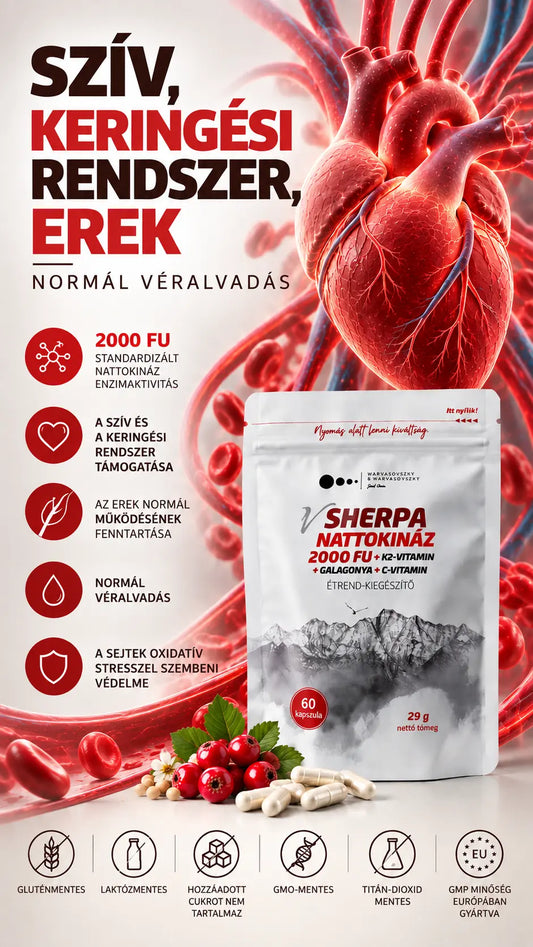

Nattokinase: Nature's Power for a Healthy Heart and Blood Vessels
Nattokinase, a natural enzyme, is derived from the Japanese food natto, which is made by fermenting soybeans with the bacterium Bacillus subtilis . This enzyme is one of the most exciting discoveries in modern nutritional science, playing a prominent role in supporting cardiovascular health. In this article, we take a deeper look at nattokinase’s effects, history, and answers some frequently asked questions.
The discovery and historical background of nattokinase
Nattokinase was first isolated by Japanese researcher Dr. Hiroyuki Sumi in 1980. During an experiment to dissolve blood clots, he discovered that natto could quickly and effectively break down fibrin, a key component of blood clots. This discovery paved the way for the development of nattokinase supplements, which are now available worldwide.
How does nattokinase work?
Nattokinase is a fibrinolytic enzyme that can break down fibrin, thus promoting blood flow and reducing the risk of blood clots. This mechanism is especially important for those who lead a sedentary lifestyle or have a genetic predisposition to thrombosis. In addition, nattokinase can stimulate the conversion of plasminogen to plasmin, which naturally breaks down blood clots in the body.
Positive health effects
- Thrombosis prevention
Nattokinase acts as a natural anticoagulant, meaning it reduces the tendency of the blood to clot. This is especially important during air travel, surgery, or prolonged immobilization, when the risk of blood clots is increased.
- Cardiovascular health
Regular consumption of nattokinase may help maintain the elasticity of your arteries, lower blood pressure, and improve overall circulatory health. Research suggests that nattokinase may reduce LDL cholesterol levels, which plays a key role in the development of atherosclerosis.
- Inflammation reduction
Inflammation is a major cause of atherosclerosis and other chronic diseases. Nattokinase may contribute to the health of blood vessel walls and reduce inflammation through its antioxidant and anti-inflammatory effects.
- Reducing the risk of stroke and heart attack
Blood clots are one of the leading causes of these serious conditions. Nattokinase is effective at dissolving fibrin, which may reduce the risk of them.
Who is it not recommended for?
- For those taking anticoagulant medications : Taking nattokinase and anticoagulants together might cause excessive bleeding.
- For those about to undergo surgery : Not recommended in the weeks before surgery due to the risk of bleeding.
- For pregnant and lactating women : Due to lack of evidence, use should be avoided during this period.
Myth: What is nattokinase not good for?
- Does not replace medical treatment : Although it can be effective as a complementary treatment, it should not be used as a substitute for medications prescribed by a doctor.
- Not a panacea for all vascular problems : Although it promotes blood circulation and fibrin breakdown, it is not effective for all cardiovascular diseases.
- Not safe for everyone : Like all natural supplements, nattokinase is not universal and there may be individual risks.
What are some common misconceptions about nattokinase?
Nattokinase is often advertised as a “blood vessel cleanser” that removes all plaque and deposits. However, this is an exaggerated claim, as atherosclerosis is a complex process that cannot be completely eliminated with a single dietary supplement.
Summary
Nattokinase can be an effective natural solution for improving blood circulation and reducing the risk of blood clots. However, it is important to use it consciously and consult a doctor about its use if necessary. Nattokinase is not a miracle cure, but when used properly, it can help maintain a healthy cardiovascular system.
Sources:
- Sumi, H., Hamada, H., Tsushima, H., Mihara, H., & Muraki, H. (1987). A novel fibrinolytic enzyme (nattokinase) in the vegetable cheese natto; a typical and popular soybean food in the Japanese diet. Experientia , 43(10), 1110-1111.
- Kim, JY, Gum, SN, Paik, JK, Lim, HH, Park, S., & Lee, JH (2008). Effects of nattokinase on blood pressure: A randomized, double-blind, placebo-controlled study. Hypertension Research , 31(8), 1583-1588.
- Wu, H., Gao, J., Bai, Z., & Wang, L. (2019). "Breaking the vicious loop between inflammation, oxidative stress and coagulation, a novel anti-thrombus insight of nattokinase by inhibiting LPS-induced inflammation and oxidative stress." Redox Biology , 2020.
- Ren, N., Chen, H., Li, Y., McGowan, E., & Lin, Y. (2017). "A clinical study on the effect of nattokinase on carotid artery atherosclerosis and hyperlipidaemia." National Medical Journal of China , 97(26), 2038-2042.